
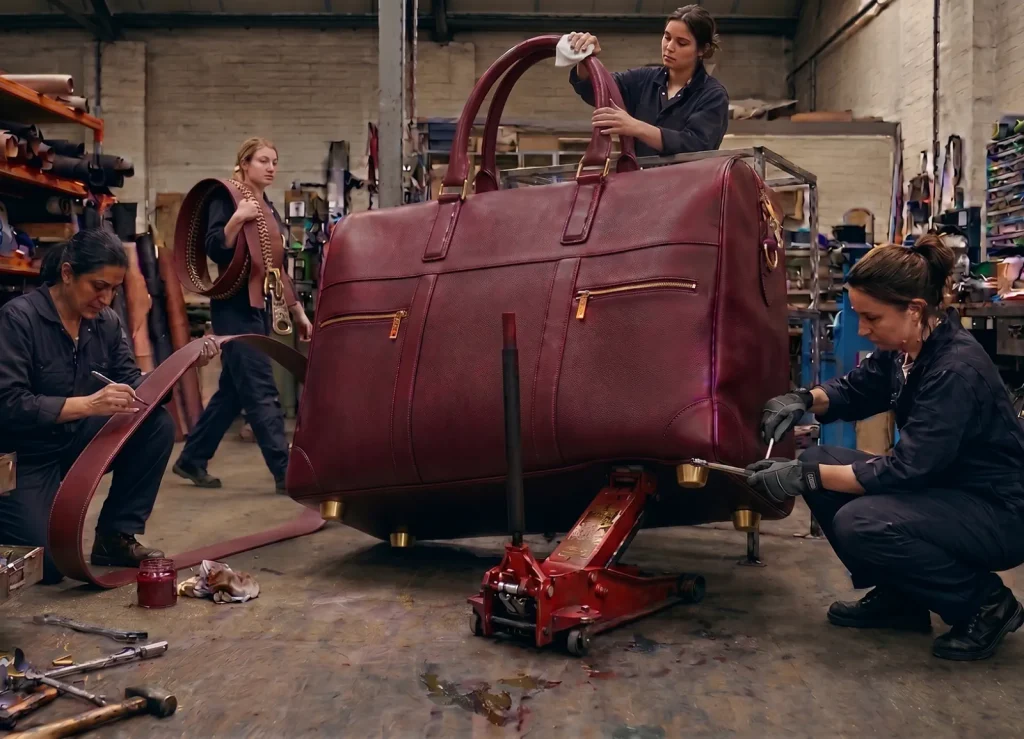
A sustainable laptop bag should not become waste because one part wears out. Handles work hard, zips get tired, leather takes the daily commute personally, and none of that should mean the whole bag has reached the end of its life.
The smarter answer is simple: repair what can be repaired, replace what makes sense to replace, and design bags so the parts that work hardest can be refreshed without buying an entirely new one. In other words, fashion could learn a thing or two from the automotive industry. Imagine throwing away a car because one door handle cracked. Exactly.
The Wear-and-Tear Waste Problem
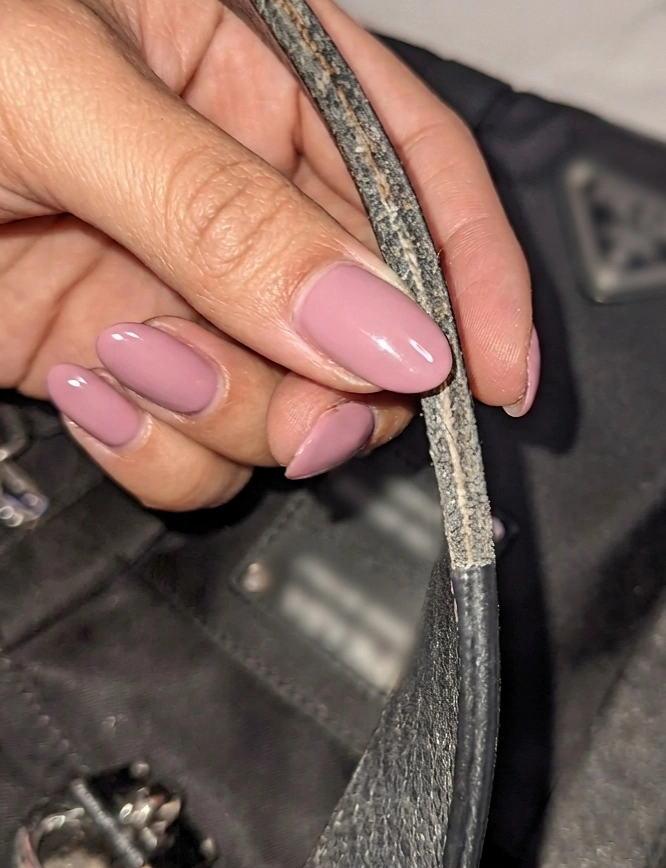
Every woman who carries her life, laptop, lipstick, charger, notebook, keys, emergency snack, and possibly three receipts from 2021 in one bag knows the truth: a work bag works. It is lifted, dropped, squeezed under train seats, placed on meeting room floors, balanced on cabin bags, and pulled open in a hurry while someone behind you at airport security performs the impatient sighing ritual. Naturally, some parts take more pressure than others: handles carry the weight, zips absorb the rush, corners meet the pavement, and shoulder straps endure the full drama of a 14-inch laptop plus ambition.
The issue is not that wear happens. The issue is that fashion has too often treated one worn detail as a reason to replace the entire bag.
The issue is not that wear happens. The issue is that fashion has too often treated one worn detail as a reason to replace the entire bag. That is wasteful. It is expensive. It is also strangely primitive for an industry that can produce six trend cycles before you finish your espresso.
That is wasteful. It is expensive. It is also strangely primitive for an industry that can produce six trend cycles before you finish your espresso.
Why Toss the Whole Bag When Only One Part Wears Out?
You should not have to throw away a whole bag because one part is tired.
A better design lets the main structure stay with you longer while the high-use parts can be refreshed, restyled, or swapped. That is the logic behind a modular laptop bag: the bag is not treated as one fixed object with one destiny. It is designed as a flexible system that can evolve.
This is where sustainability becomes practical, not performative.
A circular fashion approach is about keeping fashion and textiles in use, not simply celebrating recycling after something has already become waste. The most elegant solution is often the least theatrical one: design the product so it stays useful for longer.
Why Fashion Needs to Think More Like the Automotive Industry
The automotive industry has understood spare parts for more than a century.
When a handle breaks, you get a new handle. When a tire wears out, you change the tire. When a mirror cracks, you do not send the entire car to its philosophical ending.
Fashion, meanwhile, has somehow convinced us that a cracked handle, a damaged strap, or one worn detail can justify replacing the whole bag. This is not sophistication. It is a design failure wearing a nice coat.
Of course, a handbag is not a car. But the principle matters: products that are meant to be used every day should anticipate wear. A serious work bag should not behave like a decorative object that panics at the first sign of real life.
This is especially true for a laptop bag. A work bag is not sitting politely on a shelf waiting for compliments. It is commuting, traveling, carrying electronics, moving from office to café to train to dinner. It has a job.
So why not design it with the same common sense other industries have used for decades?
Circular Fashion Should Start Before Something Becomes Waste
Circular fashion often gets discussed at the end of a product’s life: recycling, resale, waste recovery, material sorting.
All of that matters. But starting the conversation only when the product is already unwanted is a little late, darling.
The better question is: why design products that become waste so easily in the first place?
That is also the deeper point behind discussions like From Waste to Runways: Circular Fashion Shift or Just Rebranding?, which challenges the fashion industry’s habit of turning waste into an aesthetic while the underlying system remains largely unchanged.
A recycled runway moment may photograph well. A smarter product system works every Monday morning.
For &LessBags, the goal is not to wrap sustainability in guilt or grand speeches. The philosophy is simpler and more useful: buy fewer, use longer, restyle freely.
That means designing a bag that can adapt to your life, your wardrobe, and the parts that naturally receive the most wear.
Even the EU Is Done With Fashion Waste
This shift is no longer just a nice idea floating around sustainability panels with oat milk coffee.
The European Union is moving against one of fashion’s most absurd habits: destroying unsold products before they are ever used. Under the Ecodesign for Sustainable Products Regulation, the EU is introducing rules to stop the destruction of unsold apparel, clothing accessories, and footwear, with the ban applying to large companies from 19 July 2026.
The European Commission reports that an estimated 4 to 9 percent of textile products placed on the European market are destroyed before ever being used, generating around 5.6 million tonnes of CO2 emissions. The European Environment Agency also notes that EU citizens consumed an average of 16 kg of textiles per person in 2020, which gives some scale to the problem fashion is finally being forced to face.
The message is clear: fashion waste is no longer something the industry can hide behind closed warehouse doors.
And while these rules focus on unsold goods, they point to a much bigger cultural shift. Fashion is being pushed to stop treating products as disposable, whether before they are sold or after they are used.
A sustainable laptop bag, then, should not only look responsible on a product page. It should be designed to stay in your life longer.
Why Interchangeable Add-Ons Make Sense for a Work Bag
Some parts of a bag simply work harder than others.
Handles are touched every day. Shoulder straps carry weight. Flaps protect the top opening. Laptop sleeves and pockets hold the most valuable items in the bag, and the sleeve zip is probably the most opened zip of the whole bag.
With a traditional bag, these parts are fixed into one final object. If one part wears out, your options are limited.
With &LessBag, the design is different. The bag is built around interchangeable add-ons, including handles, flap, front and back panels, shoulder strap, laptop sleeve, clutch, and clutch belt.
That means the bag can be refreshed without starting over.
You can keep the main structure and change the elements that carry the most visual or functional weight. You can update color. You can adapt the style. You can refresh the part that has lived through too many commutes.
This is not about buying more for the sake of buying more. It is about making one bag more useful for longer.
That is the difference between overconsumption and intelligent design.
Repair, Replace, Restyle: The More Sensible Fashion Logic
There is a reason “repair, replace, restyle” feels so practical.
It means repairing when the item can be cared for, replacing the specific part when that is the smartest option, and restyling when your taste, wardrobe, mood, or calendar changes. This is not a contradiction to sustainability. It is one of the most realistic versions of it.
Because women do not live static lives. Your bag needs to move from presentation to plane, from office to dinner, from black blazer day to bold color day. Expecting one fixed design to satisfy every version of your life forever ignores how women actually dress, work, travel, and adapt.
A modular work bag acknowledges reality: the base can remain stable while the add-ons evolve. The result is fewer full bags needed, less closet overload, and more freedom to express your style without treating every outfit change like a shopping emergency. It is the same logic behind a smarter capsule wardrobe, where the goal is not to own less personality, but to build more combinations from better pieces. For more on that, read The Capsule Wardrobe: Why Less Really Is More, and Why Bags Make It Harder Than It Should Be.
What &LessBags Does Differently
&LessBags was created for women who were tired of false choices.
Functional or fashionable, practical or feminine, professional or expressive, sustainable or desirable. Apparently, women were expected to lead teams, travel for work, manage deadlines, and still accept a laptop bag that looked like it was designed by someone whose main creative reference was “office printer.” No, thank you.
The &LessBag is designed in Paris and crafted in Italy using high-quality Italian grained leather, chosen for durability, scratch resistance, and a timeless look. The structure is made for everyday use, with a refined silhouette, cotton canvas lining, metal feet, a carry-on attachment zip integrated in the back panel, a laptop sleeve, and a clutch that can move from inner pocket to evening bag.
But the real difference is the modularity.
The base bag stays. The add-ons let the bag adapt.
Through the BagByMe design tool, you can personalize your &LessBag with different colors and finishes, choosing the style combination that feels like you. Not your company-issued backpack. Not a generic black box. You.
The Founder’s Industry Answer to a Fashion Problem
For Josefina Sonnerup, the founder of &LessBags, the idea of designing for longevity did not come from a vague sustainability mood board. It came from more than 12 years working in the industrial aftermarket space, where spare parts, serviceability, product lifecycle, and modular thinking are not poetic concepts. They are normal business logic.
That is exactly what made fashion feel so strangely outdated. In many industries, the question of what happens after the first sale is built into the product conversation from the beginning. Parts are expected to wear. Components are expected to be serviced. Products are designed with their future use in mind.
Fashion, however, still often behaves as if the product’s life ends at checkout. Lovely for the invoice, less lovely for the planet.
Josefina also worked for a 3D modeling company, where modularity and configuration were central topics in industrial design. In that world, product teams regularly discuss how different parts fit together, how customers can adapt a product to their needs, and how serviceability can be considered already at the design stage.
Bringing that thinking into a women’s laptop bag felt obvious. The surprising part was how little of it had been applied to fashion.
That is the engineering elegance behind &LessBags: not complexity for the sake of complexity, but a stable base, intelligent add-ons, and a design that lets women change style or refresh high-use parts without replacing the whole bag. Sometimes the most feminine thing in the room is not a bow, a slogan, or a pastel lining. Sometimes it is a woman refusing to accept bad design just because the market got lazy.
Leather, Longevity, and Realistic Sustainability
There is a reason &LessBags works with high-quality Italian grained leather.
A sustainable work bag has to survive real use. It must carry weight, keep its shape, and still look polished after the tenth train, the hundredth meeting, and the airport terminal that appears to have been designed by someone angry at luggage.
Leather is not perfect. No material is. But high-quality real leather is known for durability and long use, while many synthetic alternatives are plastic-based and can crack or peel over time. Leather Naturally explains that real leather is made to last, while many fake leathers are typically oil-based plastics.
For &LessBags, the responsible choice is not about pretending one material solves everything. It is about choosing durable materials, producing in Italy under responsible European craftsmanship standards, and designing a bag that can remain useful for years.
That is a more honest sustainability conversation.
Not perfect, just smarter.
The Next Step: A Future Part-Swapping Community
A circular fashion system becomes much more interesting when it does not stop at the product.
That is why, along the road to launch, &LessBags is also exploring the idea of a future part-swapping community among &LessBags users.
The idea is simple: if you no longer use one add-on, another woman might love it. A color that feels finished in your wardrobe could be exactly the detail someone else needs to refresh hers.
One woman’s “I have moved on from burgundy” could become another woman’s “Finally, the exact shade I wanted.”
No promises yet. Just a direction we care about.
Because the future of fashion should not only be about buying better. It should also be about sharing smarter.
What Usually Wears Out First on a Leather Laptop Bag?
The parts that usually show wear first are the ones touched, pulled, bent, or loaded most often.
Common high-wear areas include:
- Handles, because they carry the full weight of the bag
- Shoulder straps, especially when used daily with a laptop
- Zips, because they are opened and closed constantly
- Corners and bottom edges, because they meet floors, seats, and travel surfaces
- Flaps or top closures, because they protect what is inside
- Laptop sleeves, because they move with your device every day
This is exactly why an adaptable design makes sense. The parts that work hardest should not automatically decide the fate of the whole bag.
Is a Sustainable Laptop Bag Worth It?
Yes, if it is designed for real use.
A sustainable laptop bag should not only be made from durable materials. It should also help you avoid buying several bags to solve separate problems.
Instead of needing one bag for the office, one for travel, one that matches the outfit, one that holds the laptop, and one that does not embarrass you at dinner, the more intelligent answer is one bag that can adapt across those moments. That is where modularity becomes valuable: it supports both longevity and style flexibility.
In cost-per-use terms, the right bag should work hard enough to justify its place in your wardrobe. If it also reduces the need for multiple other bags, your closet gets calmer, your wallet gets less dramatic, and your style gets more precise.
A rare triple victory.
Can a Sustainable Work Bag Still Look Elegant?
Of course. The idea that sustainability must look beige, apologetic, or vaguely like a reusable grocery sack has had enough airtime. A sustainable work bag can be elegant, structured, colorful, feminine, and bold. In fact, it should be.
Professional women do not need another practical object that quietly erases their style. They need design that respects both their intelligence and their aesthetic standards.
That is the &LessBags position: function and beauty belong in the same room. Preferably on the same chair. Looking excellent.
Key Takeaways
- A worn handle, strap, zip, or detail should not mean the entire bag becomes waste.
- Fashion can learn from industries where spare parts, repair, and targeted replacement are normal.
- Circular fashion should start at the design stage, before a product becomes waste.
- EU regulation is already pushing fashion away from wasteful practices, including the destruction of unsold clothes and shoes.
- A modular laptop bag helps extend use by letting the owner refresh, restyle, and adapt key add-ons.
- &LessBags brings this logic into the modern work bag: fewer bags, more options, smarter design.
Conclusion: Let the Bag Evolve
Your work bag should keep up with your life, not collapse into irrelevance because one part had a difficult quarter.
The future of sustainable fashion is not only about what happens after something becomes waste. It is about designing products that deserve to stay in use longer, adapt more intelligently, and support the way women actually live, work, travel, and lead.
That is the point of &LessBags.
Not more bags. More possibilities from one better bag.
Explore the BagByMe design tool and create a sustainable laptop bag that can evolve with your style, your work, and your life.